
How to Play WordRank
Almost everyone hits the same wall the first time they play WordRank: you type a word, and instead of a right-or-wrong tick you get a number — something like #2,481. That is not a bug. That number is the game. This guide starts exactly there and gets you genuinely playing in about three minutes.
What that number actually means
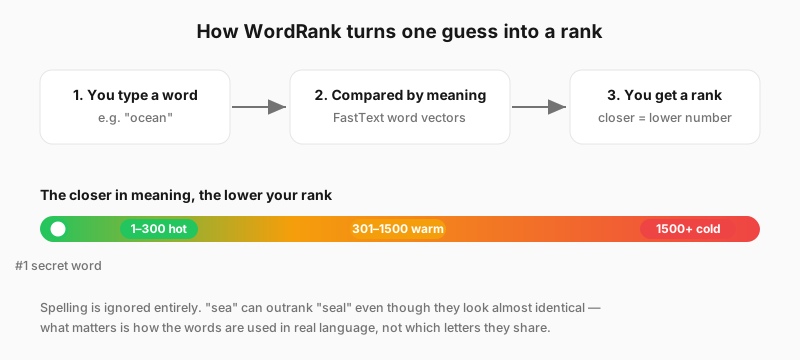
WordRank is a semantic word game, not a spelling game. Every round has one hidden secret word. When you type any word, the game measures how close it is in meaning to the secret word and returns a rank: rank #1 is the answer itself, #2 is the next-closest word in meaning, and so on. So #2,481means there are 2,480 words in the game’s vocabulary that are closer to the answer than your guess. The smaller the number, the closer you are.
This mechanic belongs to the same family as Contexto, built by a developer in Brazil, and the earlier Semantle. WordRank differs by being unlimited, multilingual, and by showing distance as one continuous color gradient rather than a few discrete bands. For the underlying semantic-similarity idea, the WordRank home page has a short explainer.
What “close in meaning” really means
Picture every word as having a circle of friends — the words it tends to show up with. “Coffee” hangs out with morning, cup, bitter, awake, shop. “Tea” hangs out with almost the same crowd. That is exactly why the game treats coffee and tea as close: not because they are the same drink, but because people talk about them using the same words.
This is also why you will hit surprises. Guess “king” and “queen” ranks close — no shock there. But “chess” ranks close too. Why? Because people constantly mention kings and chess in the same breath. The game learns how words are actually used together, not their dictionary definitions. “Close” means used in similar ways— not “same kind of thing.”
That flips your strategy. A strong next guess is not another word in the same category — it is a word that often appears alongsideyour warmest guess. If “ocean” is warm, “wave,” “sailor,” and “tide” may beat “lake,” even though a lake is more obviously “the same kind of thing.” Behind the scenes this is powered by a language model trained on billions of sentences — but you never have to think about that to play.
Start playing in three steps
- Type any word. It does not need to relate to the answer — your first word is for scouting, not for scoring.
- Read the rank. Green (1–300) means very close, amber (301–1500) means warm, red (1500+) means far away.
- Narrow down from the feedback.When a word’s rank drops sharply, keep testing words along that same meaning.
There is no guess limit and no penalty for a bad word. The fastest way to play is not caution — it is to probe widely first with words of very different meanings, locate roughly which semantic region the answer lives in, then close in.
Why spelling does not matter at all
This is the most counter-intuitive part for new players. In WordRank, “sea” can rank higher than “seal” even though they look nearly identical. The game judges how words are actually used in real language, not which letters they share. Close in meaning is not the same as similar in spelling — which is why synonyms, broader and narrower terms, and words that frequently appear together can all rank highly. Once this clicks, you have made the mental shift from guessing letters to guessing meaning.
What to do when you get stuck
Everyone gets stuck. When you do, stop circling the same word — jumping to a completely different semantic category (say, from “emotions” to “objects”) often breaks the round open. You can also use the past puzzles as a practice ground where the answer is known, purely to train your opening-word instincts. When you are ready, try today’s puzzle— or, if you want a change of pace, browse other games like Contexto.
Frequently asked questions
How do you play WordRank?
Type any word and the game returns a rank showing how close that word is in meaning to the secret word. A lower rank is closer; rank #1 is the answer. Use each rank to steer your next guess until you reach #1.
Is there a guess limit?
No. WordRank gives you unlimited guesses. You play until you find the word, and your final score is simply how many guesses it took.
Is WordRank good for beginners?
The rules take about 30 seconds to learn: type a word, read the rank, move closer. The challenge is strategy, not rules — opening with semantically broad words narrows the answer down much faster.
Can I play WordRank on mobile?
Yes. WordRank runs in any desktop or mobile browser with no download or sign-up. The on-screen keyboard is all you need.
What is the difference between WordRank and Wordle?
Wordle is about spelling a five-letter word. WordRank is about meaning — guesses are ranked by how semantically close they are, and letters are ignored entirely.
Sources
- Contexto — Sibling semantic word game; reference for the ranking mechanic.
- Semantle — One of the earliest implementations of the semantic-guessing format.
- The Washington Post — Reporting on why semantic guessing is harder than Wordle.
- fastText — The word-vector library WordRank uses to measure meaning distance.
Got it? Go try it.